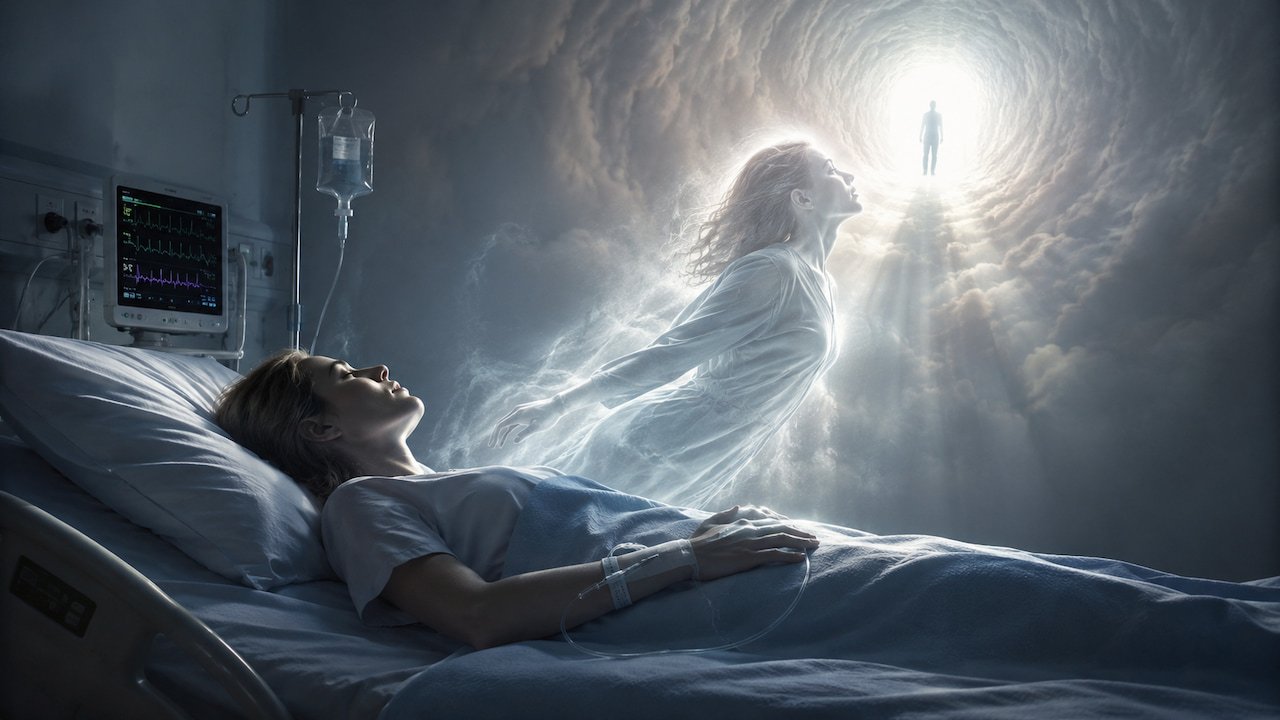
A near death experience is one of the most documented and least explained phenomena in modern science. It happens to people across every culture, religion, age group, and level of prior belief — and what it does to them afterward is so consistent, so specific, and so lasting that dismissing it as hallucination has become increasingly difficult to sustain.
More than 25 million people in the United States alone are estimated to have had one. Most don’t talk about it for years — not because it wasn’t significant, but because it was more significant than anything language comfortably handles.
What Is a Near Death Experience?
The term was coined by Raymond Moody in his 1975 book Life After Life, after he collected and analyzed near-death experience accounts from people who had been resuscitated from clinical death or who had come very close to it. What he found was not the random noise of individual imagination, but a pattern — a set of recurring elements appearing across accounts with a consistency that had no obvious explanation.
The clinical core: an NDE is a distinct conscious experience that occurs during a period of physical crisis — cardiac arrest, near-drowning, serious injury, extreme illness — in which the person reports experiences that persist after measurable brain activity has ceased or during conditions in which consciousness should not, by standard models, be possible.
Between 10 and 20 percent of people who survive cardiac arrest report an NDE. Given that hundreds of thousands of people are resuscitated annually in developed countries alone, this makes NDEs far more common than their near-absence from mainstream discourse would suggest.
The Elements — What NDE Accounts Consistently Report
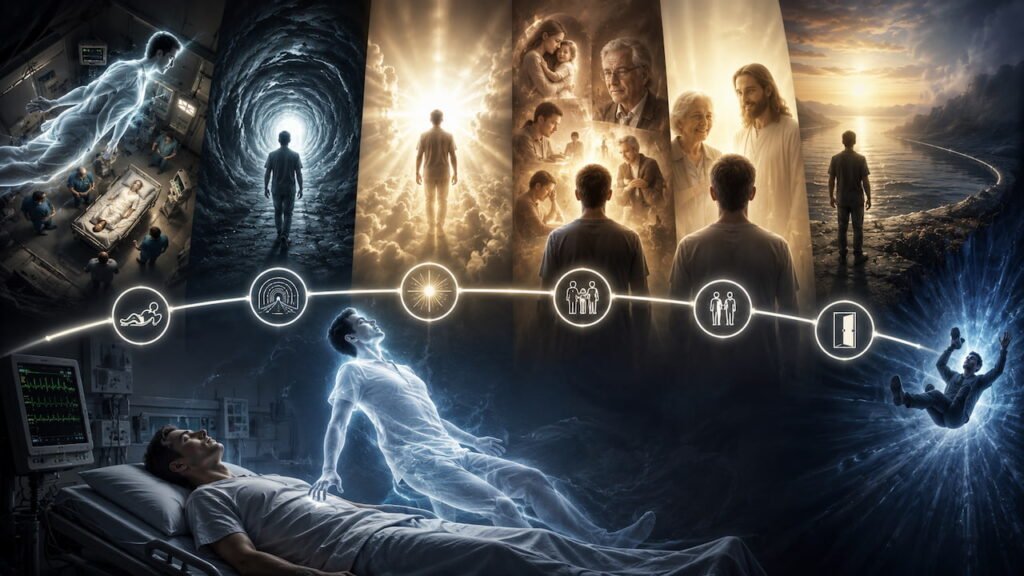
The structural consistency of NDE accounts across cultures and centuries is one of the most compelling features of the phenomenon. The elements vary in combination and sequence, but the same building blocks appear again and again.
Out-of-body experience. The sense of having left the physical body and observing it from outside — often from above. Many accounts include accurate descriptions of events in the room that the person could not have observed from their physical position.
Movement through a passage. The sensation of moving through a tunnel or dark space toward a source of light. This element appears across cultures that have had no documented contact with each other.
Encounter with light. A quality of light described as not physical — intensely bright but not blinding, accompanied by a feeling of unconditional acceptance. Those who experience it consistently describe it as more real than anything they have encountered in ordinary life.
Life review. A rapid, non-linear review of significant life events — often experienced from the perspectives of everyone involved, including those who were hurt. Not a judgment by an external authority but something closer to a complete and honest self-assessment in the presence of full information.
Meeting figures. Encounters with deceased relatives, spiritual figures, or presences of light. These figures are consistently described as more real than figures encountered in dreams or imagination.
The boundary. A threshold — described variously as a door, a body of water, a line in a landscape — that the person understands cannot be crossed without permanently leaving the physical life behind.
The return. In most cases, the return is unwilling. The person is told to return, or realizes they must — often because of unfinished responsibilities. Many describe the return to the body as more disorienting than the departure.
What’s significant is not that every account includes every element, but that accounts from a medieval mystic, a contemporary cardiac patient, and a child in rural India share structural features that had no common cultural source.
Near-Death Experience Research — The Studies That Changed the Conversation
Moody’s 1975 collection was largely dismissed by the medical establishment as anecdotal. The Dutch cardiologist Pim van Lommel changed that. In 2001, van Lommel published a prospective study in The Lancet — one of the most rigorous peer-reviewed medical journals — following 344 cardiac arrest patients over eight years. Eighteen percent reported an NDE. Several reported clear, verifiable perceptions during intervals when their EEGs showed flat lines: no measurable brain activity at all.
Van Lommel’s conclusion was not that he had proven an afterlife. It was that the data required a fundamental reconsideration of the relationship between consciousness and the brain. He wrote explicitly that the standard model — consciousness as a product of neural activity — was insufficient to account for what he had documented.
Sam Parnia’s AWARE (AWAreness during REsuscitation) studies took a different approach: placing visual targets on shelves above resuscitation tables — visible only from above — and waiting for patients who reported out-of-body experiences to describe them. The methodology was designed to produce verifiable physical evidence if out-of-body perception was genuine. Early results produced one verified hit — a patient who accurately described the targets and room layout during resuscitation. The study continues at multiple hospital sites.
In 2023, researchers at the University of Michigan published findings from EEG monitoring of dying patients. They found a surge of gamma waves — the highest-frequency, highest-complexity brain activity, associated with states of heightened consciousness — in the minutes around cardiac arrest. This is the opposite of what a dying brain would be expected to produce. The researchers stopped short of causal interpretation, but the finding is directly consistent with NDE accounts of an intensified quality of experience at the moment of death.
Bruce Greyson at the University of Virginia’s Division of Perceptual Studies has systematically catalogued NDE accounts for over forty years. What his database documents across thousands of cases is not just the experiences but their consistency: the same structural features, the same aftereffects, the same paradox of enhanced consciousness under the most compromised physiological conditions.
The paradox of the NDE is that the most vivid, most coherent, most significant experiences people report in their entire lives occur at the precise moment when the brain should be producing its least.
What the Skeptics Say — and Where the Explanation Breaks Down
The main skeptical explanations deserve to be taken seriously — because understanding where they fail requires understanding what they claim.
Oxygen deprivation. As the brain is deprived of oxygen, it can produce hallucinations. But NDEs are reported by patients whose blood gases indicated normal oxygenation. And oxygen deprivation typically produces confusion, fragmentation, and distress — the opposite of the clarity, coherence, and intensified awareness consistently reported in NDEs.
REM intrusion. The hypothesis that dreaming-brain mechanisms intrude during crisis, generating dream-like imagery. This might account for some visual elements. It doesn’t account for verified out-of-body perceptions or for the experiences of people who were born blind, who report visual content they have never had the neurological framework to imagine.
Cultural conditioning. If NDEs were projections of prior expectation, accounts should vary sharply by cultural background. They vary in surface detail and imagery — but share structural features that appear even in cultures with no prior concept of the NDE, and in young children who hadn’t yet absorbed any cultural template for death.
These explanations are not worthless. They may account for subsets of NDE features in some cases. What they don’t do is account for the phenomenon as a whole — particularly its verifiable components and its structural cross-cultural consistency. The honest scientific position here is not “explained” but “not yet explained.”
The Aftereffects — Why Transformation Is the Most Important Data Point
Of all the evidence for taking NDEs seriously, the long-term aftereffects are perhaps the most significant — because they are so specific, so consistent, and so unlike what any brain-generated hallucination would be expected to produce.
People who have had NDEs show a remarkably stable profile of lasting change across every study that has examined it: near-complete loss of fear of death; increased compassion and concern for others, sometimes at the cost of prior relationships that couldn’t accommodate the shift; reduced materialism; enhanced sense of purpose; difficulty readjusting to ordinary life — not because the experience was traumatic, but because returning felt like a demotion in the quality of reality.
These changes don’t fade. Research following NDE survivors over decades finds the profile stable — more stable, in fact, than the changes produced by most conventional therapeutic interventions. This is not the signature of a hallucination. It is the signature of an experience taken, at the deepest level of the person, as genuinely real.
The overlap with spiritual awakening is structural, not superficial. The patterns that emerge from NDEs — dissolution of the fear of death, drop in ego-driven motivation, opening to a larger sense of what’s real — are recognizably the same patterns that contemplative traditions describe as the fruits of genuine awakening. Many NDE survivors describe the experience as doing in minutes what meditation practice might take decades to approach.
Frightening NDEs — The Full Picture
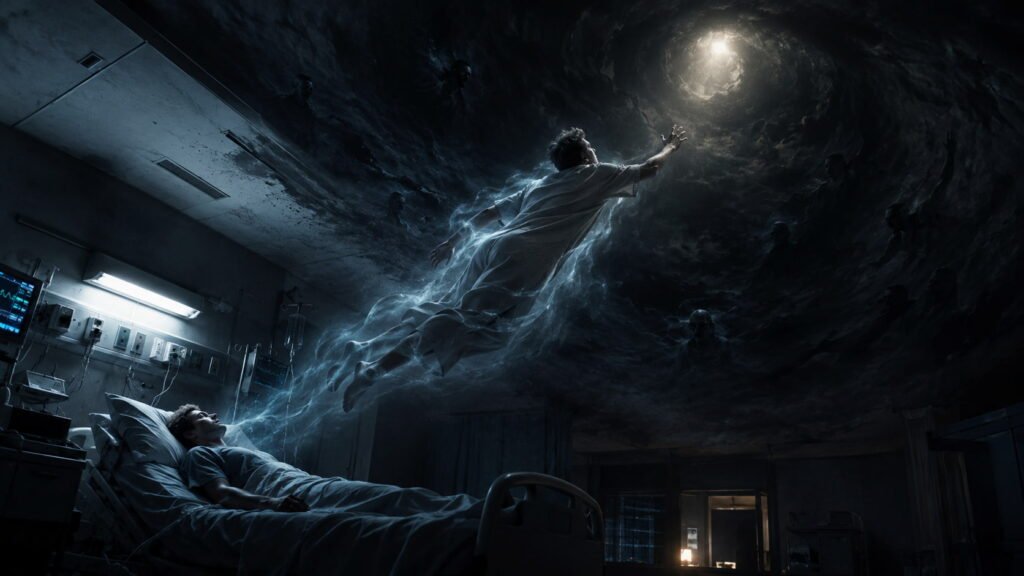
Most accounts in the popular literature are positive. Most research focuses on positive accounts, partly because positive experiencers are more willing to share. But frightening NDEs exist — between 9 and 23 percent of NDEs have negative or disturbing components — and they deserve honest acknowledgment.
These include: a sense of falling into darkness with no end, profound isolation or meaninglessness, encounters with menacing presences, or the experience of a void rather than a light. Some survivors describe something experientially analogous to what traditions call hell — not theological, but phenomenologically real in the same way the positive NDE is real.
What’s notable is that frightening NDEs produce similar long-term aftereffects to positive ones — reduced fear of death and increased meaning-orientation — though the integration process takes considerably longer and often involves significant distress. This suggests the transformation isn’t produced by the content being pleasant, but by something else: contact with a level of experience felt to be more fundamental than ordinary consciousness, regardless of whether that contact is comfortable.
The parallel to the dark night of the soul is worth noting. Painful dismantling and peaceful illumination can lead to the same place. The vehicle is not the destination.
What Near-Death Experiences Reveal About Consciousness
What NDEs point toward, taken seriously, is less a specific claim about the afterlife and more a fundamental challenge to how consciousness is modeled.
The standard materialist prediction is that any disruption of brain function should degrade the quality of conscious experience. NDEs consistently report the opposite — a shift to a state described as more vivid, more coherent, more expansive, and more real than anything in ordinary life. This is what Greyson calls the “paradox of the NDE.” The brain is at its most compromised; the quality of experience is at its most acute.
The alternative — that the brain filters or limits consciousness rather than producing it, and that extreme physiological crisis removes the filter — remains speculative. But it’s speculative in a direction the evidence supports, rather than against it. The standard explanation requires the data to be explained away. This one requires it to be taken at face value.
Understanding what happens after death may ultimately require understanding what consciousness is — which remains, as the neuroscientist David Chalmers named it, the “hard problem”: the question of why there is something it is like to be a conscious being at all, which no physical description of neural activity has yet explained. NDEs don’t solve that problem. They make it harder to pretend it doesn’t exist.
Frequently Asked Questions
What causes a near-death experience?
No definitive neurological explanation accounts for the full phenomenon. Proposed mechanisms include oxygen deprivation, REM intrusion, endorphin release, and electromagnetic field changes in the dying brain. Each explains some features; none explains all of them — particularly verified out-of-body perceptions, cross-cultural structural consistency, or the experiences of people born blind. The honest answer is that the cause remains genuinely unknown.
How common are near-death experiences?
Between 10 and 20 percent of cardiac arrest survivors report an NDE. Estimates suggest over 25 million Americans have had one — a much larger number than the absence of public discourse about it would suggest. Under-reporting is significant: many people don’t share their experience for years, or ever, because of the difficulty of communicating it and the fear of not being believed.
Can you have a near-death experience without nearly dying?
Yes. NDEs have been reported in situations of perceived imminent death (falling, drowning) where the person was not clinically in danger, during deep meditative states, in childbirth, and occasionally without any obvious crisis at all. The defining feature seems to be less the physical proximity to death and more the quality of the experience itself: the structural features, the sense of entering a different level of reality, and the lasting transformation that follows.
Can an NDE trigger a spiritual awakening?
Frequently. The aftereffect profile of NDEs — reduced ego-identification, loss of fear of death, increased compassion, reorientation toward meaning over achievement — maps directly onto what contemplative traditions describe as the changes produced by genuine awakening. Many NDE survivors report that the experience functioned as an involuntary and instantaneous version of what deliberate spiritual practice aims at over years. The two phenomena share more structural ground than is usually acknowledged.
Are near-death experiences the same across cultures?
Structurally similar, with surface variations. The core elements — out-of-body experience, passage, light, life review, boundary, return — appear across cultures with no documented mutual influence. The figures encountered, the cosmological framing, and the specific imagery vary in ways consistent with cultural background. The underlying structure does not. This cross-cultural consistency is one of the primary reasons researchers have difficulty explaining NDEs as purely culturally-conditioned projections.
What the Evidence Doesn’t Let You Do Anymore
The honest position after surveying NDE research is not certainty about what lies after death. It is the recognition that a specific position — “consciousness obviously ends when the brain stops, and anyone who thinks otherwise is naive” — has become very difficult to hold without ignoring a substantial body of serious scientific work.
That doesn’t require a leap to the opposite certainty. It requires something more uncomfortable: genuine openness. The phenomenon is real — the research has established that much. What it means about the nature of consciousness and what follows physical death remains, as it honestly should, an open question.
What’s worth noting is what happens to the people who have been through it. They don’t, in most cases, spend their remaining years in pursuit of metaphysical certainty. They spend them differently — more present, less defended, more willing to engage with what’s actually in front of them. Whether that’s because they found proof of something, or because contact with the question at that depth changes what feels worth worrying about, may be a distinction without a practical difference.