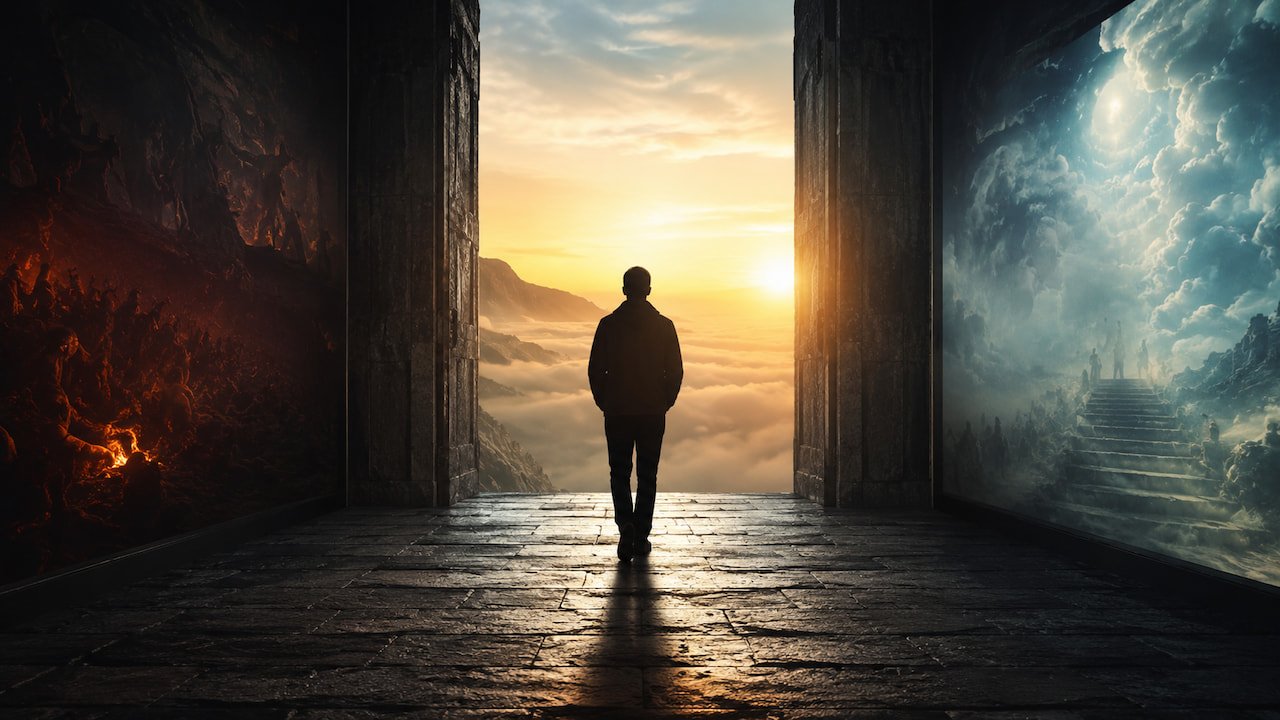
What happens after death is the question most people carry without looking at directly. It lives in the background of every serious illness, every funeral, every moment of genuine danger — and then gets filed away again when ordinary life resumes. The filing isn’t because there’s no evidence. It’s because the evidence doesn’t fit neatly into the frameworks most of us were handed.
Most people have inherited one of two default positions: the materialist view (consciousness ends when the brain stops) or the religious view (the soul goes somewhere). Both get held more from familiarity than from actual examination. What’s interesting is that serious inquiry — scientific, philosophical, and contemplative — tends to move people away from both defaults and toward something stranger and more open.
This isn’t a post that tells you what to believe. It’s a map of what’s actually been observed, reported, and thought carefully about — and what those observations invite you to consider about your own life before the question becomes urgent.
At the Moment of Death — What Science Actually Observes
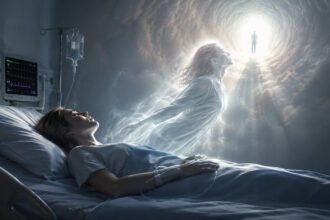
The clinical picture of death has become considerably more complex in recent decades. Cardiac arrest — the cessation of heartbeat — was once considered death. It no longer is. Thousands of people are now resuscitated after minutes without a pulse, and a significant number report experiences from that interval that shouldn’t be possible under the conventional model.
Resuscitation researcher Sam Parnia, in his AWARE (AWAreness during REsuscitation) studies, documented cases in which patients accurately described specific events occurring in the room during resuscitation — events they couldn’t have observed from their bodies, which were unconscious on the table. These accounts included descriptions of medical procedures, physical objects placed out of sight, and conversations later verified by staff. The percentage of verifiable accounts remains small, but the cases that hold up are difficult to explain within a purely brain-based model of consciousness.
Dutch cardiologist Pim van Lommel published a landmark study in The Lancet in 2001, following 344 cardiac arrest patients over eight years. Eighteen percent reported a near-death experience. Several reported clear consciousness and verified perceptions during periods when their EEGs showed no measurable brain activity. Van Lommel’s conclusion — stated carefully but explicitly — was that consciousness cannot simply be reduced to a product of neural activity, and may be associated with the brain in a way that survives its cessation.
These findings don’t prove anything about what happens after permanent, irreversible death. But they do seriously complicate the assumption that consciousness ends the moment the brain stops — which is what most people accept without examination.
Near-Death Experiences — The Most Consistent Data We Have
Between five and ten percent of the general population reports a near-death experience. Across different cultures, ages, languages, and religious backgrounds, these accounts share a striking structural similarity: the sensation of leaving the body, moving through a dark passage, encountering an intense light, feeling profound peace, meeting figures associated with the deceased, and in many cases being told — or choosing — to return.
Raymond Moody, who first systematically documented NDE accounts in Life After Life (1975), noted that one of the most consistent features wasn’t the specific content of the experience, but the transformation it produced. People who had NDEs overwhelmingly lost their fear of death, developed a deeper concern for others, and underwent a fundamental shift in how they understood consciousness. These changes persisted for decades — not the profile of a hallucination or an oxygen-deprivation artifact.
Bruce Greyson at the University of Virginia’s Division of Perceptual Studies has spent decades systematically studying NDE accounts and their aftereffects. What his research documents across thousands of cases is a consistent pattern: reduced death anxiety, increased compassion, the lasting sense that consciousness is primary rather than secondary to the physical body, and a reorientation from achievement toward meaning.
The standard neurological explanation — NDEs as the product of a dying brain releasing endorphins, experiencing oxygen deprivation, or generating a final dream sequence — doesn’t adequately account for several key features: verified perceptions of events the patient couldn’t have observed from their body, experiences reported by people born blind who describe visual content, consistent structural content across radically different cultures, and the specific, durable profile of psychological change that follows. These are not features of hallucinations.
What Happens After Death? What the Major Traditions Say
Contemplative traditions across cultures have been sitting with this question for millennia. What’s striking, when you look past the surface differences in imagery and cosmology, is how much structural agreement there is underneath.
The Tibetan Buddhist tradition — most elaborately documented in the Bardo Thodol, the Tibetan Book of the Dead — describes death not as an ending but as a transition through a series of intermediate states. In this view, the moment of death brings an encounter with the “clear light” of pure awareness — the same awareness present in deep meditation, now undisguised by the structures of ordinary mind. The entire map is less about what objectively happens and more about how the quality of consciousness at death shapes what follows.
The Hindu Vedantic tradition holds that the Self — Atman — was never born and therefore cannot die. What we take ourselves to be — the body, the personality, the accumulated memories and preferences — is the temporary form the self takes in a given life. Death, within this framework, is the dissolution of the form while the Self remains unchanged. The metaphor used across many teachers in this lineage: a wave returning to the ocean. The form dissolves; the ocean loses nothing.
Western mystical traditions — Jewish Kabbalah, Christian mysticism, Islamic Sufism — carry similar structural ideas under different names. The consistent emphasis across all of them is on the degree of identification with form at the time of death. Those who have come to understand themselves as more than the form tend, within these frameworks, to move through death differently than those entirely identified with it.
The Stoics, who were not primarily metaphysical in orientation, held that the animating principle of a person was not destroyed at death but returned to the larger whole from which it came. Marcus Aurelius meditated on death regularly — not as something to dread but as something clarifying: a reminder that what matters is how you inhabit the life you have, not the preservation of any particular form.
Every tradition that has sat with death long enough arrives at the same place: the thing you are most afraid of losing is not the thing you actually are.
The Deeper Question — Does Consciousness End, or Does the Container?
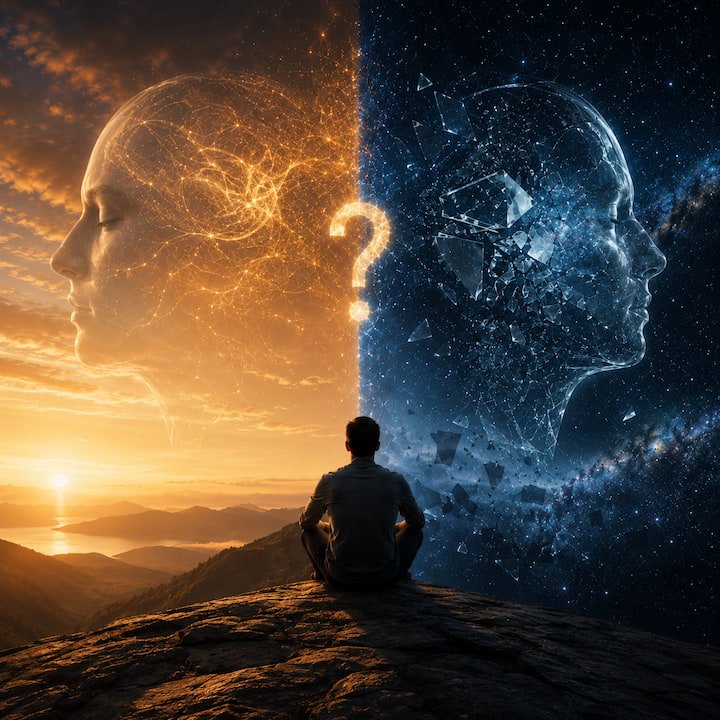
The most fundamental question underneath “what happens after death” is not really about death at all. It’s about what consciousness is.
The standard materialist assumption is that consciousness is produced by the brain — that mind is a byproduct of neural activity, like heat from an engine. Under this view, when the engine stops, the heat disappears. Death is final because there is nothing to survive.
But this assumption has never been demonstrated. It is taken as obvious, but the “hard problem” of consciousness — how subjective experience arises from physical processes at all — remains entirely unsolved. No neuroscientist has explained why there is something it is like to see red, feel grief, or be afraid. The brain can be mapped in extraordinary detail, and neural events can be correlated with experiences, but correlation is not production.
An alternative view — held by a minority of scientists but a majority of contemplative traditions — is that the brain does not produce consciousness but filters it. Aldous Huxley described the brain as a “reducing valve”: limiting the full range of consciousness to whatever is useful for navigating a physical body in a physical world. On this model, death is not the end of consciousness but the removal of the filter. What remains would be the whole, undivided awareness that the brain had been narrowing down to the familiar stream of personal experience.
This is speculative — as any serious position on this question has to be. But it is no more speculative than the standard materialist assumption. Both are philosophical positions held in the absence of conclusive evidence. The difference is that one takes seriously the data that exists — NDE accounts, consciousness research, contemplative testimony — while the other requires that data to be systematically set aside.
Within spiritual awakening, this question becomes less abstract. People who have undergone genuine awakening experiences — moments in which identification with the personal self temporarily dissolves — often report that what follows is not a belief about consciousness surviving death but something more direct: a recognition that what they most fundamentally are was never, in its nature, the kind of thing that ends.
The Death of the Ego — A Rehearsal for the Real Thing
Many spiritual traditions treat the ego’s dissolution not as a metaphor for death but as a genuine encounter with it. The dark night of the soul — the profound disorientation that often accompanies awakening — has been described by contemplatives across traditions as a kind of dying. The structures that organized the self collapse. The future that seemed certain evaporates. The familiar ground disappears.
What’s notable about accounts of people who have moved through this process — and also about NDE accounts — is that the fear of literal death typically diminishes dramatically afterward. Not because they’ve been given certainty about what happens, but because the direct experience of losing the self they most identified with didn’t end in annihilation. What they found on the other side was not nothing. The pattern appears too consistently across too many cultures and centuries to dismiss as coincidence.
In this sense, the stages of awakening can be understood as practice for death — not morbidly, but practically. Each time identification with the story, the role, the personality loosens — a small rehearsal occurs. The fear of death is, in most cases, the fear of the self’s dissolution. When that dissolution has been met and survived, the fear changes its character fundamentally.
Why Your Answer to This Question Changes Everything
The question of what happens after death is often treated as purely metaphysical — interesting perhaps, but practically irrelevant. This is wrong. How you answer this question shapes, silently and persistently, how you live.
If death is the absolute end — if consciousness is simply extinguished and nothing persists — the implicit logic tends toward: accumulate as much as possible before the lights go out, minimize pain, protect the self. Not necessarily consciously, but that is the logic the belief tends to run in the background.
If something persists — if the quality of consciousness at the time of death matters, if how you lived shapes what follows, if the connections made in this life have some form of continuation — the logic changes. The emphasis moves from accumulation to development. From self-protection to genuine presence. From filling time to using it deliberately.
Even if you remain genuinely uncertain — which is the most intellectually honest position available — the practice of living as if consciousness is more than the brain predicts tends to produce a different quality of attention. That orientation keeps in view what the purely materialist default tends to obscure: that what you are doing right now, and what you are bringing to each encounter, may matter in ways that extend beyond the visible.
The shift that follows genuine awakening tends to move in exactly this direction — not through argument but through direct recognition. People who come through NDEs with a transformed relationship to death don’t typically emerge with certainty about the specifics of the afterlife. They emerge with a different sense of what is fundamentally real. And with that shift, the question of what happens after death becomes less urgent than the question of how deeply one is actually living now.
Frequently Asked Questions
What happens after death according to science?
Science doesn’t have a definitive answer. Research shows that brain activity persists for seconds to minutes after cardiac arrest, and that a significant percentage of resuscitated patients report coherent, verifiable perceptions during periods of no measurable brain activity. The assumption that consciousness simply ends with the brain is a philosophical position, not an established scientific fact. The “hard problem” of consciousness — how subjective experience arises from physical processes — remains entirely unsolved.
Are near-death experiences evidence of an afterlife?
They’re evidence that consciousness is more complex than the standard materialist model predicts. NDE research from van Lommel, Greyson, and others documents consistent experiences across cultures, some with verifiable perceptions that couldn’t have been made from the physical body. The lasting psychological changes — reduced death anxiety, increased compassion, shift in values — don’t fit the profile of hallucinations. Whether this constitutes evidence of an afterlife in the traditional sense remains genuinely open.
Do all spiritual traditions agree on what happens after death?
The specifics vary considerably. But structural similarities appear across traditions: consciousness continues after the body’s death; the quality of consciousness developed during life affects what follows; death is a transition rather than an ending. The cosmological details differ — Buddhism describes intermediate states and rebirth, Hinduism describes the undying Self, Christianity describes soul continuity — but the structural claim underneath is remarkably consistent.
How can I reduce my fear of death?
The most effective approach seems to be direct examination rather than avoidance. Most NDE accounts, and most contemplative traditions, report that the fear of death diminishes significantly when the question is looked at honestly rather than filed away. Distinguishing between the fear of dying (pain, loss of function) and the fear of death itself (non-existence) is a useful first step. Contemplative practices that involve loosening identification with the personal self tend to shift the relationship with death over time — not by providing answers, but by changing what feels most fundamentally at stake.
What happens to consciousness after death?
No one knows with certainty. The honest position is that the data — NDE research, consciousness studies, contemplative reports — doesn’t support simple annihilation, but doesn’t prove survival in any specific form either. The most intellectually rigorous position available is genuine openness: taking seriously the evidence that complicates dismissal, without manufacturing certainty about what that evidence means.
What Remains When the Question Is Held Honestly
The honest answer to what happens after death is: we don’t know. What we have is evidence that complicates simple dismissal, traditions that converge on structural claims about consciousness, and the direct testimony of people who came close enough to the edge to report something from it.
What we also have — and this may be more useful — is the recognition that the question itself is not separate from the life being lived right now. The people who seem least afraid of death are not, in most cases, the ones who found a comfortable belief system to explain it. They are the ones who developed, through contemplative practice or life experience, some direct acquaintance with what they most fundamentally are — and found, in that acquaintance, something that doesn’t seem to be the kind of thing that ends.
The wave doesn’t need to be afraid of returning to the ocean. The character in the dream doesn’t need to defend against the morning. Whether these analogies point to anything literally true is, perhaps, the wrong question. What they do — what this entire inquiry does, when held honestly — is shift the center of gravity from the form to what animates it. And that shift changes not just how one thinks about death, but how one shows up for everything that precedes it.